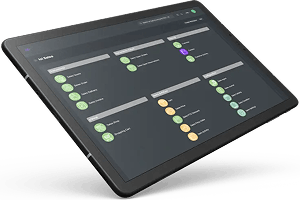


With the “ioi stock stamp” module, you automatically obtain a monthly snapshot of your stock quantities and stock values. A single click is enough to activate this feature. You instantly gain access to a historical overview of your stock quantities and stock values. Extremely useful for analysis and for reviewing your month-by-month evolution. Simple, practical, and straightforward.
A calculation of stock turnover is also immediately available. The stock turnover level (in days) is strategic information. It allows you to clearly identify which items should be prioritized for sale and which items require a reduction of their minimum stock levels. High stock turnover means low immobilized capital (inventory) combined with strong profitability.
The stock snapshot is presented item by item, but also in summarized form by grouping keys (family, type, group, subgroup). Monthly detailed data can automatically be deleted after a certain period in order to optimize disk space usage, while summaries by family, type, and group are retained.
With the “ioi Period stock value” module, we offer an approach to stock valuation that is highly appreciated by finance professionals and corporate auditors. The variation in stock quantity and value is calculated per site through the historical tracking, period by period, of all valued stock entry and exit documents.
Documents such as goods receipt notes and delivery notes, assigned to accounting periods, are used as calculation and evidence elements for stock variation. This highly rigorous method ensures alignment between financial directors, auditors, board members, and shareholders.
It is possible, with specific privileges, to assign a document to a different accounting period than the document date itself. Example: a late goods receipt entered in the current month, while the actual unloading took place two days earlier in the previous month.
To secure this valuation process, the system provides period opening and closing privileges, making it possible to block any modification once the results have been finalized.
With Silicon ioi, you have access to several stock valuation methods: the traditional weighted average cost, the last purchase price (managed in parallel), as well as FIFO stacking (First In, First Out).
For items managed by batch or serial number, the acquisition or production cost is stored per batch and per serial number. If you work with technical projects or make-to-order production, we offer direct cost allocation for purchases. Nothing is more precise, controllable, and auditable.
For production processes, it is possible to enforce that all materials and services are fully integrated before stock entries are made. This ensures your cost calculation remains fully accurate.
That is completely understandable. More and more, we see customers switching from weighted average cost valuation to valuation based on the latest acquisition price. Why? Because the market is highly dynamic, and working with a stock value based on past prices can make you believe you are performing well, while market prices are actually increasing and you should, in reality, adjust your selling prices. A decrease in acquisition prices produces opposite but similar effects.
Silicon ioi allows you to work with both methods in parallel: the average value and the latest purchase price.
Profitability is a key concept in any business. As soon as you create quotations, the Silicon ioi ERP system stores the cost of each item directly within every sales line. This provides immediate visibility into the margin or added value of each quotation.
A low-margin alert system helps guide sales representatives during the sales process. Once the sale is confirmed, the stored margin is updated in the order, then carried through deliveries and invoicing. This historical tracking of costs throughout the sales chain enables you to monitor your company’s added value on a daily basis.
A full set of standard reports and charts is available. If pricing updates occur, you can adjust and distribute new margins to be applied within documents for clearly defined date ranges. This ensures you always have a relevant and reliable tool, even in changing market conditions.
We are a company operating multiple sites, each with its own stock management. Silicon ioi allows you to manage these inventories separately. You have full visibility over the warehouses of each site, and stock valuation is calculated independently per site.
Movements between warehouses within the same site are handled through transfers. These transfers can be performed using portable mobile scanners connected via WiFi or 5G. Inter-site transfers are managed through inter-site delivery notes and goods receipt notes. These documents can also be completed by warehouse operators using mobile scanners.
The JIT (Just in Time) engine can automatically generate “mirror” purchase orders between sites. An internal supplier order sent to another site automatically generates an internal customer order on the receiving site. Within these inter-site transfers, you can define your own valuation rules, for example by using the cost price increased by a margin.
Purchasing is a profession in itself. Buying efficiently improves your profitability and your competitiveness on the market. That is why the Silicon ioi ERP system offers multi-purchase-price management for your items. Each price can be linked to specific purchasing conditions and discounts.
You can define prices or discounts based on quantities according to your suppliers, as well as minimum order quantities and order multiples. What does the concept of multiples mean? These are the quantities you may order once you exceed the minimum quantity. Example: the minimum quantity is 12 and the multiple is 6. You can therefore order 12, then 18, 24, and so on.
It is also advisable to define a preferred supplier, while the others become alternative suppliers. From one supplier to another, references may vary. With Silicon ioi, the reference, barcode or QR code, as well as the description, can all be managed separately. This ensures that you always order using the correct reference, barcode, and description.
It is very important to register your supplier’s barcode. This allows you to use the Android mobile scanners provided. The mobile barcode receiving tool makes it possible to retrieve the purchase order and correctly value your stock as soon as goods enter the warehouse.
When purchasing from a new supplier, through a quotation request or a purchase order, you can ask the Silicon ioi ERP system to automatically store this new supplier in the purchase catalogs. This makes the supplier easily available for future orders.
It is also possible to activate an automatic update of the sales price whenever the purchase price changes. Your pricing therefore becomes dynamic.
In addition, if you have implemented the e-shop offered by Silicon ioi, price updates are automatically triggered from new supplier orders.
Having many possibilities for managing purchase prices can be very useful, but when starting out, Silicon ioi allows you to work simply with one purchase price, one margin, and one sales price. Simple, efficient, and without unnecessary complexity.
The system will automatically, without any additional workload, create a multi-supplier price catalog as well as a multi-condition sales price catalog. This means you are immediately ready to evolve toward more advanced purchasing and sales management.
Data import is also simplified: one reference, one description, one purchase price, and one sales price are enough to become operational.
Having the right sales price allows you to increase your sales while maintaining your margin. Silicon ioi offers a scalable configuration that adapts to your needs. The simplest approach is to directly define a sales price excluding or including VAT within the product record.
The e-shop can be launched immediately once you have defined a classification and added a few images. Market prices evolve constantly, and your suppliers regularly provide pricing updates. After importing these new price lists, you can use the integrated tools to redefine your margins and sales prices.
My business is structured or seasonal, and I want to prepare my price lists in advance with activation on a specific date. With Silicon ioi, I can use an existing price list as a basis and create a new sales catalog by adjusting the margins.
I choose the switch-over date, and the new prices are automatically applied. The switch is managed by sales journal, making it possible to define different activation dates depending on the country or region. I can also apply these prices for a defined period before automatically returning to the standard pricing.
Quantity-based discounts are an excellent sales driver. With Silicon ioi, you can define discounts tailored to your customers’ purchasing behavior.
Examples:
- From 10 units: 15% discount instead of 10%
- Additional 4% discount on top of the existing 10%
- Fixed discount of -€2
- Price reduced from €12 to €9
Quantity-based discounts are not always the most suitable approach. For a more eco-responsible strategy, we provide a sales incentive solution that avoids encouraging overconsumption by offering discounts based on a total purchase amount within a product category.
Example: purchasing a vacuum cleaner together with its accessories allows the customer to reach a threshold that grants a discount. This type of discount encourages useful and consistent purchases.
With Silicon ioi, this mechanism is managed through value thresholds per product category. On the e-shop, the remaining amount required to reach the threshold is automatically displayed.
A product can be sold individually or in packs (6, 12, etc.). Each packaging unit has its own barcode. With Silicon ioi, only one price is managed, while quantities are automatically adjusted during scanning.
Examples:
- Scan of a pack of 6 → quantity = 6
- New scan → quantity = 12
- Addition of one unit → quantity = 13
To remain efficient, simplicity is essential. Avoiding the need to apply my own labels and instead using my supplier’s barcode saves a significant amount of handling time and reduces labeling errors. For example: if your supplier has already placed an EAN13 barcode on the product packaging, you might as well use it.
The Silicon ioi ERP system supports this as a standard feature. However, in some situations, you may keep your own sales reference while changing suppliers depending on pricing conditions. In that case, your warehouse or store shelves may contain products sold under the same name but carrying different barcodes.
Silicon ioi allows you to manage as many barcodes as needed for sales scanning. To secure your references, the system checks whenever a new barcode is added to ensure it is not already assigned to another product. This functionality is also fully compatible with the Android mobile scanners offered by Silicon ioi.
This addresses another important need: managing warranties for products with serial numbers without adding unnecessary administrative burden.
Traceability for more and more products has become necessary, and in some industries even mandatory, to guarantee product safety and quality. In an ERP system such as Silicon ioi, this is normally managed through batch management or serial number tracking. These features are available as standard.
However, this type of management can become administratively and logistically demanding. It requires additional rigor and workload, which may quickly become cumbersome. Silicon ioi therefore offers a method called late traceability.
With this method, batch or serial numbers only need to be defined at the delivery stage rather than upon goods receipt. This means that physical traceability (outside the IT system) must still be properly maintained within your company when products are received. As long as this process is respected, your traceability remains valid.
Important: in certain industries, regulations require fully computerized traceability in order to guarantee a strict, continuous, auditable, and permanently traceable flow. In such cases, this late traceability method cannot be applied. You should therefore verify the applicable requirements in your sector. Examples of incompatible sectors include pharmaceutical, medical, and military products.
Practical example to better understand the late traceability method proposed by Silicon ioi: I sell power drills and want to know which serial numbers were sold, together with the sales date and the related customer. In the Silicon ioi ERP system, I activate the “late traceability” option on the product. All purchasing and stock management activities remain identical to those of a standard product. The only difference is that, at the time of delivery, the system requires the serial or batch number being sold to be specified. Without this information, it is impossible to complete the delivery or perform a counter sale.
In Silicon ioi, you can retrieve these serial or batch numbers directly from previous deliveries, making warranty management straightforward. If your supplier reports a defective product associated with a list of serial or batch numbers, you can immediately identify which customers received those products and organize a recall process.
To go even further, if your supplier provides delivery notes containing serial or batch numbers, you can scan these documents and attach them to your goods receipt notes in the ERP system. Thanks to indexed PDF search capabilities, you can quickly locate the relevant receipts.
This method improves efficiency during goods reception. You avoid having to encode every serial number upon receipt (imagine opening pallets to manually register hundreds of references). Likewise, during internal stock movements, you do not need to identify each individual serial number being moved.